
What is Nitrox for liveaboard divers
16 September 2026
Nitrox is one of the most useful certifications for divers who plan liveaboard trips. It can give more no stop time, reduce nitrogen loading on repetitive dives and make multi-day dive schedules easier to manage. It also adds oxygen rules that every certified Nitrox diver must follow.
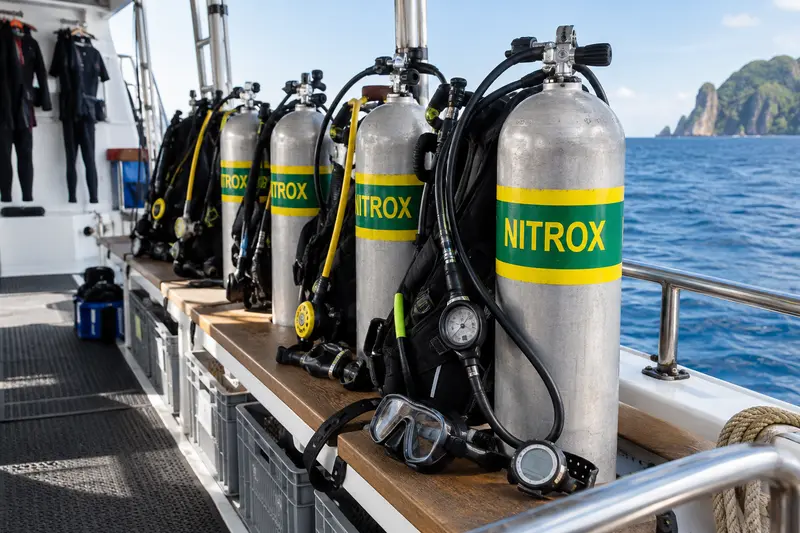
Nitrox cylinders are marked so divers can identify the gas and confirm the analyzed oxygen percentage before diving.
Short answer
Nitrox is enriched air. It has more oxygen and less nitrogen than normal air. The benefit is not the extra oxygen itself. The benefit is breathing less nitrogen, which can extend no stop time or reduce nitrogen loading. The limit is oxygen exposure. A diver must analyze the tank, set the computer correctly and stay shallower than the maximum operating depth for that blend.
What is Nitrox?
Nitrox is a breathing gas made from nitrogen and oxygen. Recreational divers usually mean enriched air Nitrox, also called EANx or enriched air. Air is about 21 percent oxygen and 79 percent nitrogen. Enriched air has more than 21 percent oxygen, so it has less nitrogen.
Two common recreational blends are EAN32 and EAN36. A diver might say Nitrox 32, EAN32 or enriched air 32. The number is the oxygen percentage. Divers Alert Network notes that NOAA Nitrox 1, or NN32, was named for that 32 percent oxygen mix.
How Nitrox changes a dive
Nitrox changes dive planning because it changes the gas fractions. Less nitrogen means less nitrogen uptake at the same depth and time compared with air. This can be used in two main ways.
| Use | What it means | Important limit |
|---|---|---|
| Longer no stop time | The diver uses the Nitrox setting on a compatible dive computer to gain longer no decompression limits where the blend allows it. | The diver must stay within oxygen exposure limits and shallower than the maximum operating depth. |
| Lower nitrogen loading | The diver follows air limits while breathing Nitrox, which can reduce nitrogen exposure for the same profile. | This does not remove decompression risk. Normal ascent rates, safety stops and conservative planning still apply. |
DAN explains that enriched air increases the oxygen fraction and reduces the nitrogen fraction, which means less nitrogen uptake at a given depth. DAN also notes that Nitrox is not a deep-diving gas. Higher oxygen brings a shallower maximum operating depth, and exceeding that depth raises the risk of oxygen toxicity.
Why Nitrox matters on liveaboards
Liveaboards often involve several dives per day over several days. That is where Nitrox becomes practical. The benefit is usually most visible on repetitive dives, because residual nitrogen affects later dives.
Some boats record Nitrox as complimentary for certified divers. Others charge extra. Confirm the exact boat and departure. See liveaboards with free Nitrox tanks for checked complimentary rows, and should I dive with Nitrox on a liveaboard for whether it is worth paying for on a given trip.
Nitrox is especially useful when the route includes moderate-depth reef dives, repetitive dives, photography dives or long dive days. It is less useful when dives are shallow enough that gas supply, current, temperature or site rules end the dive before no stop time becomes relevant.
What Nitrox does not do
- It does not let a diver go deeper. Higher oxygen content usually reduces maximum depth.
- It does not replace certification, planning or gas analysis.
- It does not remove the need for ascent control, safety stops or hydration.
- It does not remove narcosis planning. Plan Nitrox dives for narcosis as you would air dives at the same depth.
- It does not mean every liveaboard includes free Nitrox. Policies differ by boat.
Oxygen exposure and MOD
The main Nitrox risk is oxygen exposure. More oxygen becomes more important as depth increases because partial pressure rises with pressure. The maximum operating depth, or MOD, is the deepest depth at which a blend should be used for a chosen oxygen partial pressure limit.
DAN states that the recreational scuba community generally recommends a maximum oxygen partial pressure of 1.4 ATA. For 32 percent Nitrox, DAN gives an MOD of 112 feet at that 1.4 ATA limit. For 36 percent Nitrox, DAN gives 95 feet. Recreational divers should not exceed 1.6 ATA. DAN oxygen toxicity guidance treats 1.6 ATA as a slim-margin ceiling, not a working target for a normal dive. CMAS recreational limits use a maximum 1.4 bar PO2 for the bottom mix and 1.6 bar for a stop.
For metres, a common formula is: MOD = ((PO2 limit / oxygen fraction) - 1) x 10. Example for EAN32 at PO2 1.4: ((1.4 / 0.32) - 1) x 10 = 33.7 m. That matches the DAN 112-foot figure. Certification depth, route rules, conditions and local law may be shallower. Do not plan to the last metre of the oxygen limit.
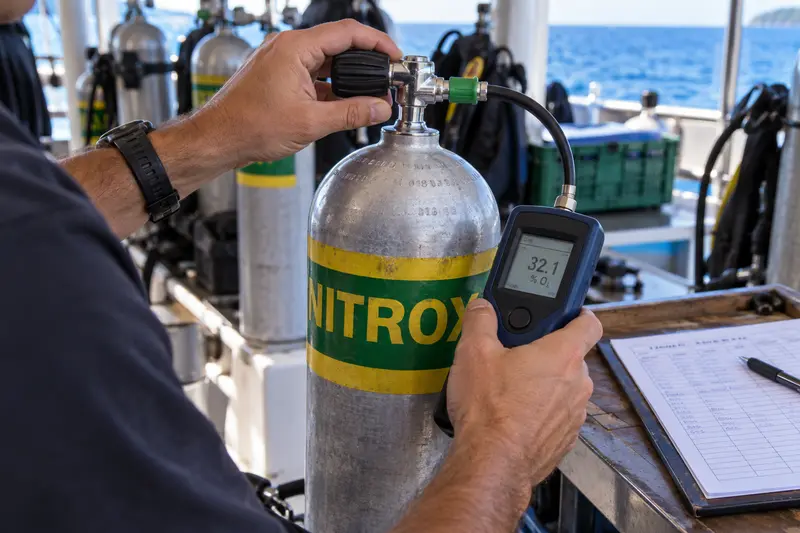
The diver using the tank should verify the oxygen percentage and confirm the MOD before diving.
How to measure Nitrox
Nitrox is measured with an oxygen analyzer. DAN says divers using enriched air should always analyze the oxygen content of their cylinders. Follow the analyzer manufacturer instructions and the boat fill-station procedure. The usual sequence is:
- Turn the analyzer on.
- Calibrate it in air, normally to about 20.8 to 21 percent oxygen, using the flow rate recommended for that analyzer.
- Flow gas from the Nitrox cylinder across the sensor at the same controlled rate used during calibration.
- Wait long enough for the analyzer to clear the previous air and show a stable oxygen reading.
- Do not blow into the sensor. Moisture can affect accuracy and sensor life.
- Record the analyzed oxygen percentage, MOD, date, cylinder details and diver name where the fill log or tag requires it.
- Set the dive computer to the analyzed oxygen percentage, rounded according to the computer manufacturer guidance.
The diver who will use the cylinder should verify the reading. If the analyzed percentage does not match the expected blend, do not dive that tank until it is confirmed.
How to use Nitrox on a liveaboard
The safest workflow is a simple routine before every Nitrox dive day and before any cylinder switch.
- Confirm that you are Nitrox certified and that the boat has your certification on file.
- Ask what blend is being supplied. Many liveaboards use EAN32, but do not assume.
- Analyze the cylinder yourself or directly watch the analysis.
- Write down the oxygen percentage and MOD if required by the boat procedure.
- Check the cylinder label or tag against the cylinder you will actually use.
- Set your dive computer to the analyzed gas.
- Check your buddy's computer and gas setting during the buddy check.
- Stay shallower than the MOD and within your computer's no stop and oxygen limits.
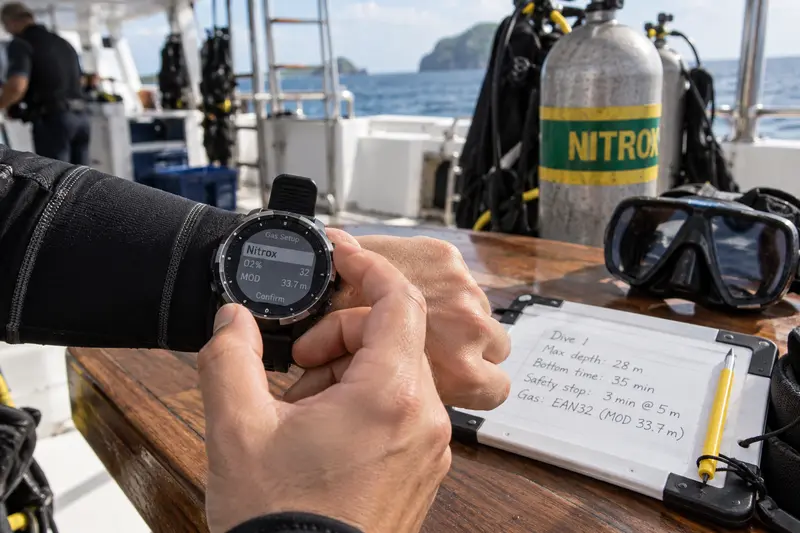
Computer setup is part of the Nitrox safety check. The gas setting must match the analyzed tank.
When Nitrox is worth paying for
Nitrox is usually worth serious consideration when the trip has many repetitive dives, moderate depths or profiles where air no stop time becomes a limit. It is also useful when the diver wants a more conservative nitrogen profile by staying within air limits while breathing Nitrox.
It is less important when dives are very shallow, short, limited by gas supply, or limited by temperature or current. It is also not a shortcut for advanced or deep diving training.
For liveaboards, the booking question is not only "Is Nitrox available?" It should be:
- Is Nitrox included or extra?
- What blend is normally supplied?
- Is Nitrox available for every dive or only daytime dives?
- Is the Nitrox course available onboard?
- Are 12L tanks included, and are 15L Nitrox tanks available if needed?
- Does the route require a dive computer, SMB, torch or minimum certification?
FAQ
What is Nitrox?
Nitrox, also called enriched air or EANx, is a nitrogen and oxygen breathing gas with more than 21 percent oxygen. More oxygen means less nitrogen than normal air.
Does Nitrox let divers go deeper?
No. Nitrox usually reduces the maximum operating depth because higher oxygen content raises oxygen partial pressure at depth.
Why is Nitrox useful on liveaboards?
Liveaboards often involve repetitive diving. Nitrox can reduce nitrogen loading or extend no stop time when used within training, depth and oxygen exposure limits.
Who should analyze a Nitrox tank?
The diver who will use the cylinder should personally verify the oxygen percentage, confirm the maximum operating depth, set the dive computer and sign the fill log where required.
Is Nitrox safer than air?
It depends how it is used. Nitrox can reduce nitrogen exposure for the same dive profile. It also increases oxygen exposure, so it is too simple to call it safer than air.
Can I use Nitrox without a certification?
No. Reputable fill stations and liveaboards require proof of Nitrox certification before supplying enriched air cylinders to divers.
Does Nitrox reduce fatigue?
Divers often report feeling less tired, but that should be treated carefully. The stronger factual reason to use Nitrox is nitrogen management and no stop time, not a promised fatigue effect.
Can Open Water divers use Nitrox?
Yes, if they are Nitrox certified and stay within their certification depth, training and local rules. Nitrox does not extend a diver's certification depth.
Sources
Facts in this article are taken from public diving-medicine pages and from DiveScanner's checked Nitrox boat list. Confirm the exact boat and departure before booking.
- Divers Alert Network: Nitrox (enriched air, 1.4 ATA recreational PO2, MOD for 32 percent and 36 percent)
- Divers Alert Network: oxygen toxicity (1.6 ATA as a recreational ceiling, not a working target)
- Divers Alert Network: understanding oxygen toxicity (analyze the oxygen content of Nitrox cylinders)
- CMAS recreational diving limits (1.4 bar PO2 for the bottom mix, 1.6 bar for a stop)
- Liveaboards with free Nitrox tanks (checked complimentary Nitrox rows)